
The Problem with Traditional "Battle Drills"
Battle drills are misunderstood and misapplied, but is there a better way?


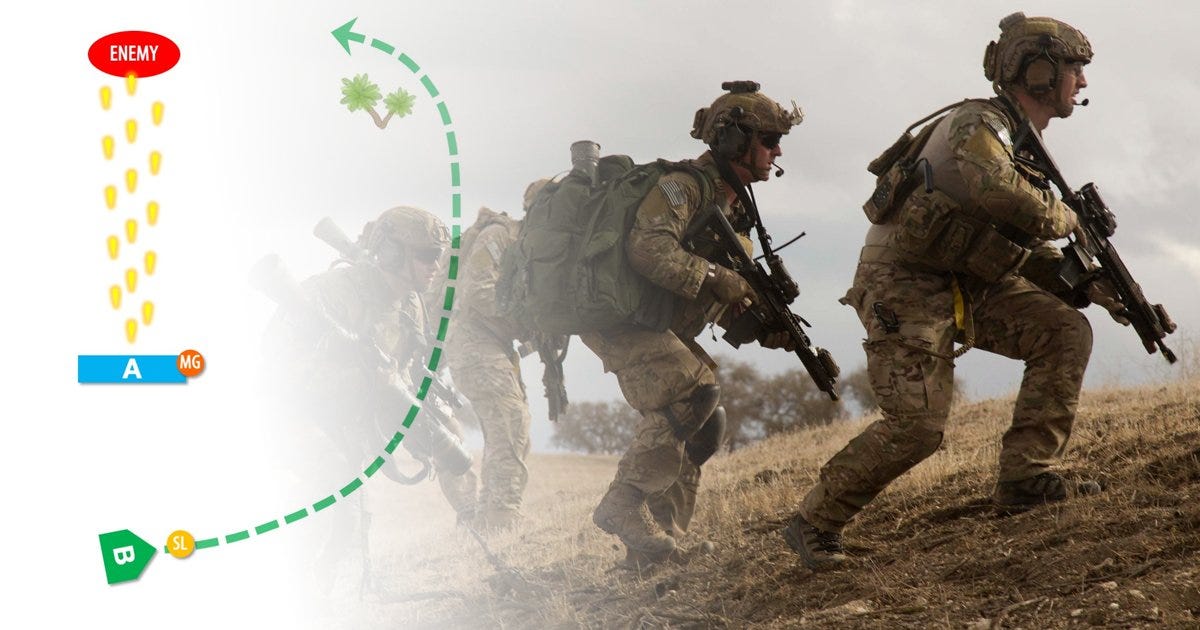
This article is drawn from our Small Unit Infantry Rural Combat book which we plan to publish here on Substack in serial form. It covers the problems with executing the classic “suppress and flank battle drill” in a rigid, formulaic manner. We welcome your reactions, comments and constructive criticism in the chat.
The Problem with “Suppress and Flank”
Over recent years the U.S. Army has changed it’s philosophy on “battle drills” several times but there remains a core problem that is difficult for mere doctrinal changes to correct. The problem is that battle drills are often misunderstood, mis-taught and misapplied. The key first point that is clearly written in most manuals but is often completely ignored is that battle drills are not intended as a rigid prescription that must be followed to the letter. Battle drills are a guideline or start point upon which to build and adjust your tactics based on the situation.
The second, often misunderstood logic of battle drills is that they are primarily designed to buy time for leaders to make a better, more flexible decision based on the situation. The idea behind a battle drill is that it gives the unit something to execute (or begin executing) right away in order to retain the initiative and keep the enemy off balance while the leader gathers information, assesses the situation and comes up with a better course of action.
Unfortunately, the way battle drills are described in manuals and taught in schools tends to cause leaders to forget the two points above and drift back into a rigid, process-based execution that looks exactly like the diagram in the manual. Attempting to fight in this way can lead to disastrous results in real combat. The rest of this article will explain why.
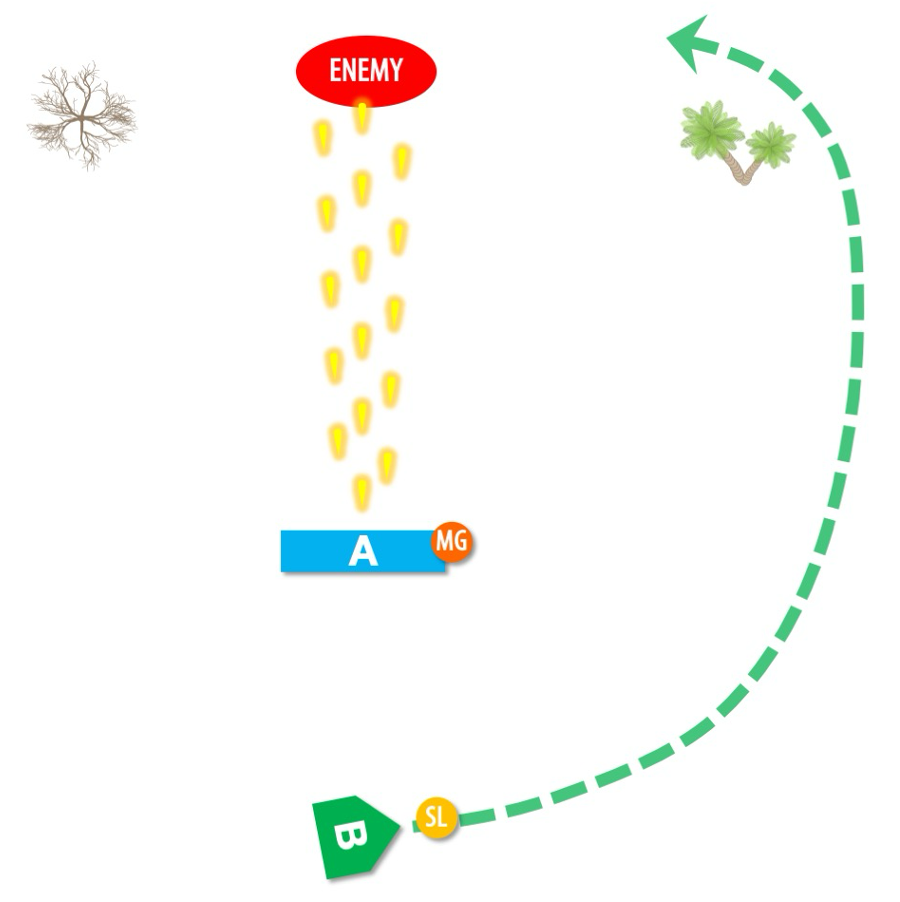
For sake of space, we assume readers are already familiar with the standard “suppress and flank” battle drill. For those who are not, refer to the diagram below. In general terms the suppress and flank battle drill involves one element (A) laying down suppressive fire while a second element (B) moves around to the right or left in a wide, bold flank to attack the enemy unexpectedly from the side.
PROBLEM 1: Engagement Distance and Ammo Load
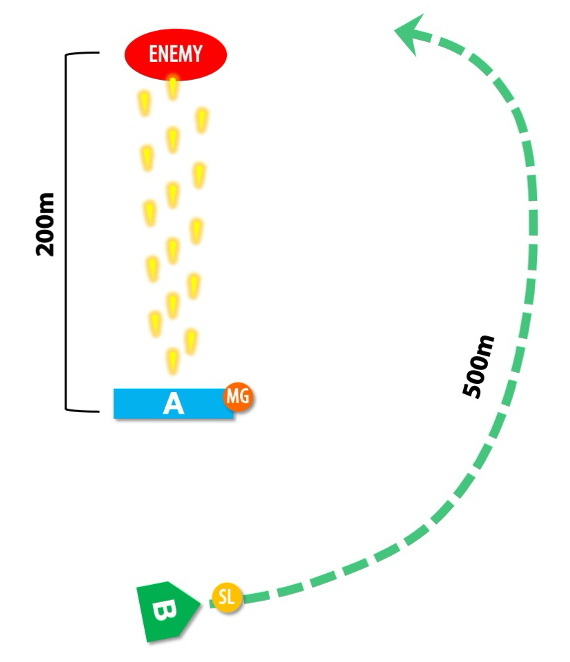
A typical engagement range in conventional warfare could be as far as 200m or 300m. This means if the flanking element makes even a moderately bold flank (as shown in the picture, the total movement distance for the flanking element will likely be farther than 500m. Moving 500m over rough terrain in full gear, especially at night can take time. Then consider that if the machine guns in the support position are firing at a sustained rate of fire, based on standard U.S. Army basic ammo loadouts, the light machine guns will have possibly expended their ammunition and the medium machine guns will likely be at least half-empty by the time the assault element is in position to assault.
PROBLEM 2: Exposure to New Threats and Isolation
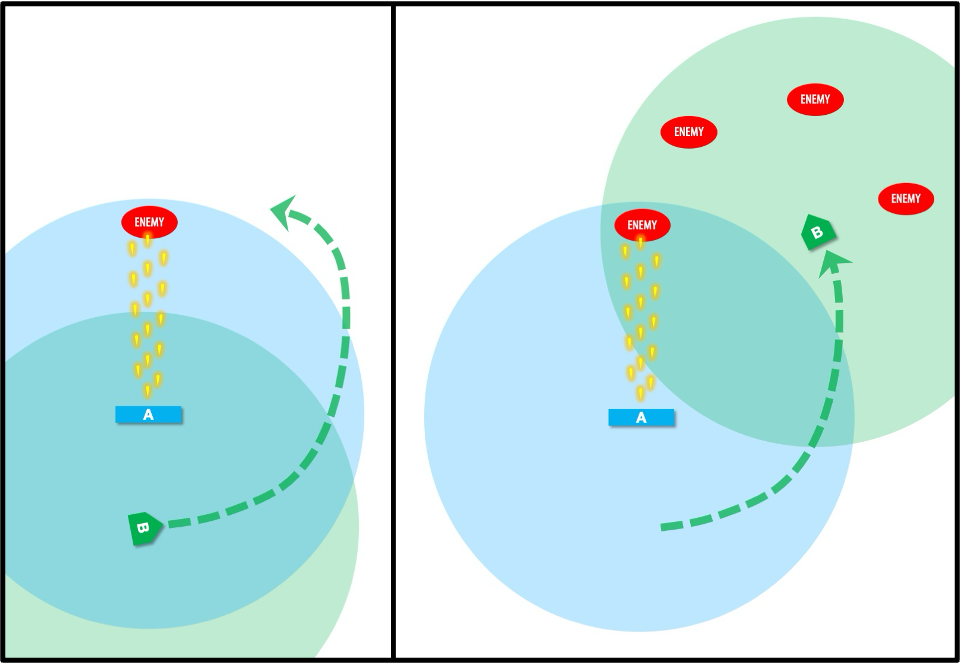
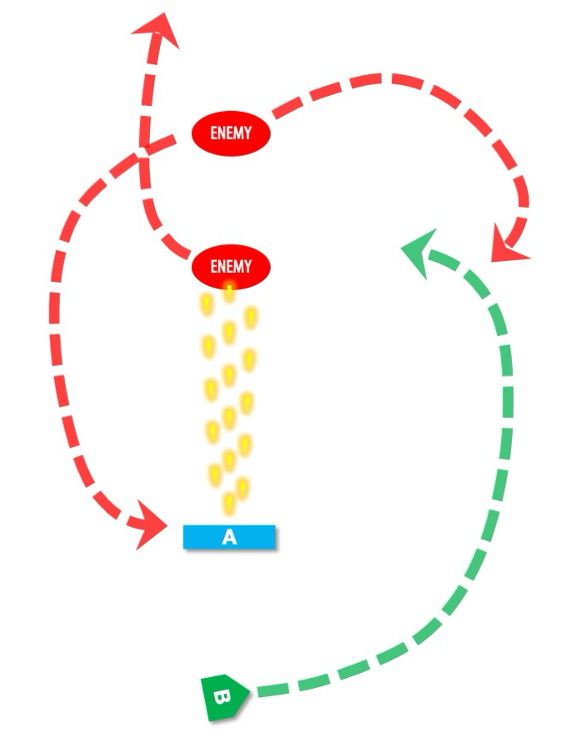
Given the engagement distances just discussed, by the time the flanking element is approaching the assault position, it will be able to see a lot farther and a lot more than the area originally visible to the support element. In the example below with shaded observation areas, the lead team understandably makes contact near the limit of its observation range and will see only one enemy element. As the trail team flanks around and moves ahead, it may see and be exposed to additional enemy elements that are not visible to the support element. The support element therefore cannot provide covering fire to help protect the flanking element from these new threats. This could leave the flanking element completely isolated while facing potentially superior forces.
PROBLEM 3: Unpredictable Enemy Reaction
The basic battle drill formula also assumes that the enemy either chooses to do nothing or is unable to do anything because they are completely suppressed by supporting fires. While either of these results is possible, it would be foolish to assume that the enemy will do nothing in every case. Combined with the possibility mentioned earlier of additional enemy units further away that you didn’t initially spot, there are quite a few possibilities for enemy counteraction. The enemy might attempt to flank you from the same side or the opposite side of your flanking element. The enemy might attempt to attack and destroy your support element or anticipate your flank and wait in ambush for your assault element. Even more likely, the enemy will simply try to pull back and break contact. Any of these actions changes the scenario and makes the basic battle drill formula break down in some way.
PROBLEM 4: Enemy Indirect Fire
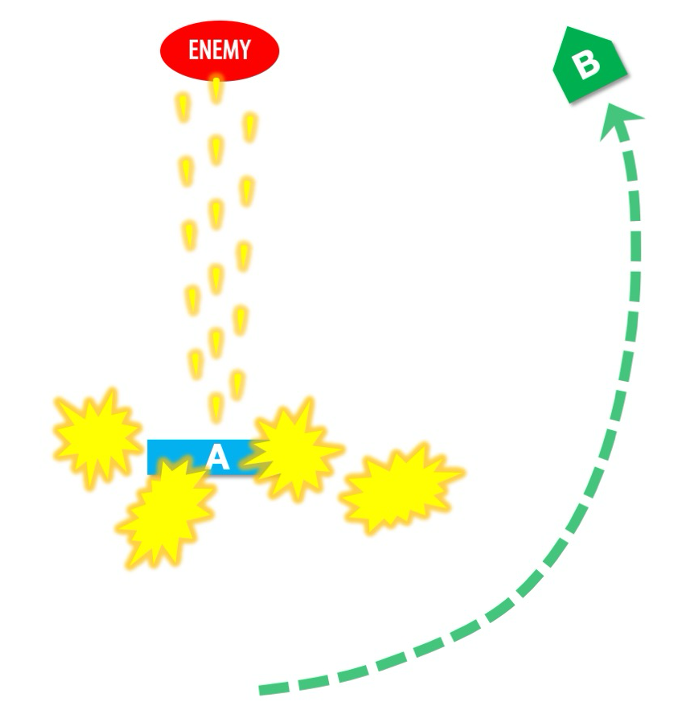
As already discussed, depending on the engagement range it can take the assault element a while to bound around into the assault position. If the enemy has indirect fire assets like mortars or artillery, he will likely call in a fire mission as soon as the engagement starts. You should study patterns for enemy artillery employment and response time in your area of operations to know the approximate time window you have before rounds start falling on your support-by-fire position. If the enemy response time is fast, it might not be safe or wise to leave a supporting element in place for a long period of time.
PROBLEM 5: Attacks from Other Directions
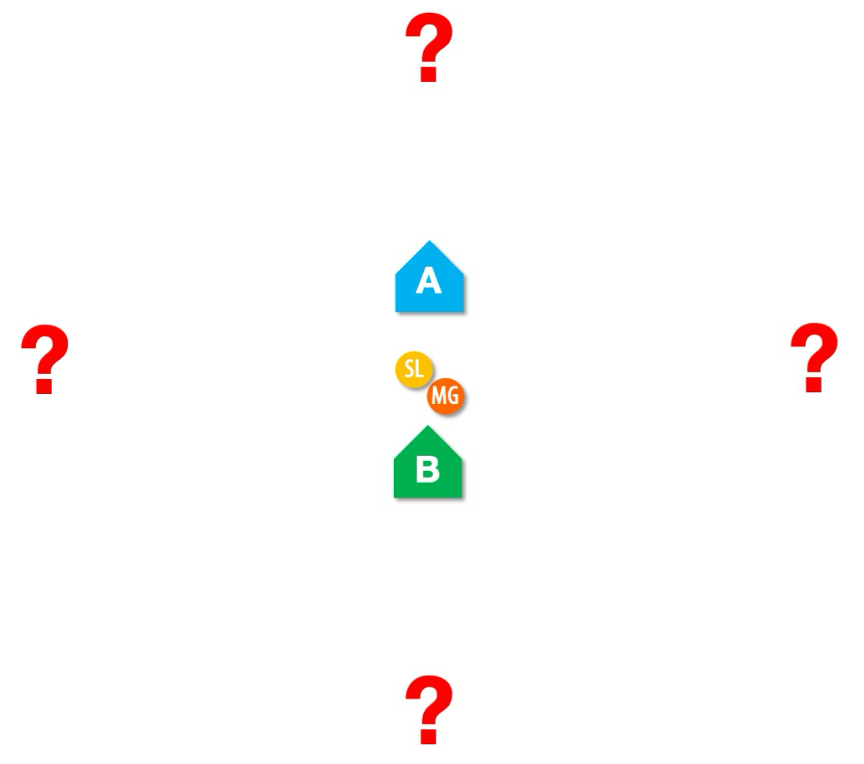
Battle drills as explained in doctrinal manuals can be applied to enemy contact in any direction. However, because the specific examples, drawings and steps in the manuals often focus on contact to the front, military units frequently end up practicing only attacks to the front and fail to practice executing the battle drill in different directions. While the fundamental steps and movements of the drill remain generally the same, there are some important changes in how you execute the drill based on the direction from which the attack is coming. Taking a more flexible approach to fire and maneuver from the outset sets you up for success when encountering enemies from different directions.
An Alternative to Battle Drills?
We believe that part of the reason why battle drills are misunderstood is because they are expressed as “drills” in the first place. It is difficult to give someone a “drill” but then expect them to deviate from it based on the situation. The spirit of adaptability should be built in to the way doctrine is written, taught and practiced from the start.
We suggest one approach to achieve this goal in our manuals that we call “Battlecraft.” We chose the term battlecraft because the term “craft” suggests a deeper, nuanced and adaptable tactical understanding beyond a rigid drill or process. You can learn more about this approach in upcoming articles.
We hope you found the short article useful and once again we welcome your reactions, comments or suggestions below in the chat area. We want to promote constructive discussions on tactics with people from various tactical backgrounds and experience levels.
The intent of the enemy’s initial contact maybe to force you to flank. The assault force then ends up in an engagement area.
You have to train leaders to assess the situation and make a decision
Following on from the previous insightful comments, I wonder how landmine and IED threats factor into troop movements. These threats could be alongside what is described in the article, in probable ambush sites, and in other areas of interest.